- Ruwanwelisaya
- Thuparamaya
- Ridi Vihara
- Lovamahapaya
- Abhayagiri Dagaba
- Jetavanarama
- Mirisaveti Stupa
- Lankarama
- Isurumuniya
- Rathna Prasadaya
- Dakkhina Stupa
- Sela Cetiya
- Naka Vihara
- Kiribath Vehera
- Pubbarama
- Tapovana
Ruwanwelisaya:

The Ruwanwelisaya is a stupa in Sri Lanka, considered a marvel for its architectural qualities and sacred to many Buddhists all over the world. It was built by King Dutugemunu c. 140 B.C., who became lord of all Sri Lanka after a war in which the Chola King Elara, was defeated. It is also known as Mahathupa, Swarnamali Chaitya, Suvarnamali Mahaceti (in Pali) and Rathnamali Dagaba.
This is one of the Solosmasthana (the 16 places of veneration) and the Atamasthana (the 8 places of veneration in the ancient sacred city of Anuradhapura). The stupa is one of the world's tallest monuments, standing at 103 m (338 ft) and with a circumference of 290 m (951 ft).The Kaunghmudaw Pagoda in Sagaing, Myanmar is modeled after this stupa.
The largest Stupa after Ruwanwelisaya was build in was the Kotmale Mahaweli Maha Seya. This stupa took 33 years and 3 months to complete.
The stupa was an ancient ruin in the 19th century. After fundraising efforts by Sinhalese bhikkhu, the stupa was renovated in the early 20th century.The Ruwanveli Seya Restoration Society was founded in 1902 and the final crowning of the stupa took place on 17 June 1940.
Thuparamaya:
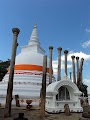 Thuparamaya dagoba has been built in the shape of a bell. This dagoba was destroyed from time to time. During the reign of King Agbo II it was completely destroyed and the King restored it. What is seen presently is the construction of the dagoba, done in 1862 AD. As of today, after several renovations, in the course of the centuries, the monument has a diameter of 59 ft (18 m), at the base. The dome is 11 feet 4 inches (3.45 m) in height from the ground, 1641⁄2 ft (50.1 m) in diameter. The compound is paved with granite and there are 2 rows of stone pillars round the dagaba. During the early period a vatadage was built round Thuparamaya.
Thuparamaya is a dagoba in Anuradhapura, Sri Lanka. It is a Buddhist sacred place of veneration.
Mahinda Thera, an envoy sent by King Ashoka himself introduced Theravada Buddhism and also chetiya worship to Sri Lanka. At his request King Devanampiyatissa built Thuparamaya in which was enshrined the collarbone of the Buddha. It is considered to be the first dagaba built in Sri Lanka following the introduction of Buddhism. This is considered the earliest monument, the construction of which was chronicled Sri Lanka. The name Thuparamaya comes from "stupa" and "aramaya" which is a residential complex for monks.
Ridi Vihara:
Ridi Viharaya or Silver Temple is a 2nd-century BCE Theravada Buddhist temple in the village of Ridigama, Sri Lanka. Built during the reign of Dutthagamani of Anuradhapura, the temple is considered as the place where the silver ore, which providedsilver to complete Ruwanwelisaya; one of the largest stupa in Sri Lanka, was discovered. According to the chronicles Mahavamsa and Thupavamsa, the Ridi Viharaya complex was built in gratitude for helping him cherish his dream of completing Ruwanwelisaya.
Associated buildings, structures and locations
Serasum Gala:
A rock to the right of the entrance, which is believed to be the place where the initial temple was built. It is also considered that this was the place where king Dutthagamanidressed prior to worshipping the temple. A small stupa is located on top of this rock.
Waraka Welandu Wiharaya:
 Waraka Welandu Viharaya is a Polonnaruwa era building, considered as the place where the Arhat monks accepted jackfruit from the merchants. The name "Waraka Welandu Viharaya" (temple which the jackfruit was consumed) implies this notion. This small Gedige-type building of the size of a room, is built in stone and contains a number of Kandyan era paintings. Its stone roof rests on eight stone pillars, which are decorated on all four sides. Hindu influence can be observed in the carvings of female dancers, which are usually not found in Buddhist temples.
Hewisi Mandapaya:
Located in front of the Maha Viharaya, the Hevisi Mandapaya (or the drummers' pavilion) contains a rice bowl and other objects of historical value. A centuries-old Pallakkiya, which was used to carry elderly monks, can also be seen hung on its roof.
Maha Viharaya:
 Maha Viharaya, or the main temple, is located inside the Rajatha lena (or thesilver cave); a massive rock which takes the shape of a cobra head. This cave is considered as the place where the original silver ore was found. Various monarchs, including Amandagamani Abhaya (21-31 CE) and Parakramabahu I of Polonnaruwa (1153-1186 CE) have sponsored the reconstruction and expansion of this temple, which is the oldest of all buildings in the complex.It contains a number of Buddharupa in various gestures. This include a 9-metre recumbent Buddha statue and an Anuradhapura era-gold plated Buddha statue. According to Ridi vihara asna, a chronicle, the latter was brought down from India.Other statues: including an ancient statue which is believed to be of king Dutthagamani, eight standing Buddha statues, an Avalokiteśvara statue and areclining Buddha statue donated by Burma can also be seen inside this building. The floor in which recumbent Buddha statue is placed, is decorated with Dutch era porcelain floor tiles: popularly known as "Bible tiles".These blue-and-white tiles portray various biblical figures and stories such as expulsion from the Garden of Eden, dove of peace, prophets of yore, the last supper, burning bush and the creation of man.These tiles were gifted to king Kirti Sri Rajasinha by a Dutch envoy. All rooves and walls of Maha Viharaya are decorated with paintings.
Uda Viharaya:
Uda Viharaya, or the upper temple belongs to the Kandyan era, and contains a seated Buddha statue with Makara Thorana and a Sandakada pahana (moonstone). This Sandakada pahana is a unique design, as it takes a semi-circular shape instead of a triangular shape, which is more common in similar designs of Kandy era.There are also sculptures of Hindu deities around the main statue. The chamber contains paintings of mythological animals and Ravana: a main character of the legend, the Ramayana. A stupa is located by the right side of this temple. At the entrance, is a Hindu devalaya, which is dedicated to the protector god of the area.
Lovamahapaya:
 Lovamahapaya is a building situated between Ruvanveliseya and Sri Mahabodiya in the ancient city of Anuradhapura, Sri Lanka. It is also known as the Brazen Palace or Lohaprasadaya because the roof was covered with bronze tiles.In ancient times, the building included the refectory and the uposathagara (Uposatha house). There was also a simamalake where the Sangha assembled on Poya days to recite the sutra of the confessional. The famous Lohaprasada built by King Dutugemunu, described as an edifice of nine stories, was a building of this class. One side of the building was 400 ft (120 m) in length. There are 40 rows, each row consisting of 40 stone pillars, for a total of 1600 pillars. It is believed that it took six years for the construction of the building and the plan was brought from the heavens. The building was completely destroyed during the reign of King Saddhatissa.
Whilst the Jetavanaramaya, Abhayagiriya and Ruwanwelisaya were taller structures, the Lovamahapaya remained the tallest building of the island for over a millennium between 155BC and 993AD. The small building displayed now is a recent construction and is the Venue of Uposatha (chapter house) of the Maha Vihara even now.
Abhayagiri Dageba:
 Abhayagiri Vihāra was a major monastery site of Mahayana, Theravada and Vajrayana Buddhism that was situated in Anuradhapura, Sri Lanka. It is one of the most extensive ruins in the world and one of the most sacred Buddhist pilgrimage cities in the nation. Historically it was a great monastic centre as well as a royal capital, with magnificent monasteries rising to many stories, roofed with gilt bronze or tiles of burnt clay glazed in brilliant colors. To the north of the city, encircled by great walls and containing elaborate bathing ponds, carved balustrades and moonstones, stood "Abhayagiri", one of seventeen such religious units in Anuradhapura and the largest of its five major viharas. One of the focal points of the complex is an ancient stupa, the Abhayagiri Dagaba. Surrounding the humped dagaba, Abhayagiri Vihara was a seat of the Northern Monastery, or Uttara Vihara and the original custodian of the Tooth relic in the island.
The term "Abhayagiri Vihara" means not only a complex of monastic buildings, but also a fraternity of Buddhist monks, or Sangha, which maintains its own historical records, traditions and way of life. Founded in the 2nd century BC, it had grown into an international institution by the 1st century AD, attracting scholars from all over the world and encompassing all shades of Buddhist philosophy. Its influence can be traced to other parts of the world, through branches established elsewhere. Thus, the Abhayagiri Vihara developed as a great institution vis‑a‑vis the Mahavihara and the Jetavana Buddhist monastic sects in the ancient Sri Lankan capital of Anuradhapura.
 Jetavanaramaya:
The Jetavanaramaya is a stupa located in the ruins of Jetavana in the sacred world heritage city of Anuradhapura, Sri Lanka. Mahasena of Anuradhapura (273–301) initiated the construction of the stupa following the destruction of the mahavihara. His son Maghavanna I completed the construction of the stupa.A part of a sash or belt tied by the Buddha is believed to be the relic that is enshrined here.
The structure is significant in the island's history for it represents the tensions within the Theravada and Mahayana sects of Buddhism; it is also significant in recorded history as one of the tallest structures in the ancient world;and the second tallest non-pyramidal buildings after Pharos (lighthouse) of Alexandria; the height of the stupa is 400 feet (122 m),making it the tallest stupa in the ancient world. The structure is no longer the tallest, but it is still the largest, with a base-area of 233,000 m2 (2,508,000 sq ft). Approximately 93.3 million baked bricks were used in its construction; the engineering ingenuity behind the construction of the structure is a significant development in the history of the island. The sectarian differences between the Buddhist monks also are represented by the stupa as it was built on the premises of the destroyed mahavihara, which led to a rebellion by a minister of King Mahasena.
This stupa belongs to the Sagalika sect. The compound covers approximately 5.6 hectares and is estimated to have housed 10,000 Buddhist monks. One side of the stupa is 576 ft (176 m) long, and the flights of stairs at each of the four sides of it are 28 ft (9 m) wide. The doorpost to the shrine, which is situated in the courtyard, is 27 ft (8 m) high. The stupa has a 8.5 m (28 ft) deep foundation, and sits on bedrock. Stone inscriptions in the courtyard give the names of people who donated to the building effort.
Mirisawetiya Dageba:

The Mirisaveti Stupa is situated in the ancient city of Anuradhapura, Sri Lanka.King Dutugamunu (161 BC to 137 BC) built the Mirisaveti Stupa after defeating King Elara. After placing the Buddha relics in the sceptre, he had gone to Tissa Wewa for a bath leaving the sceptre. After the bath he returned to the place where the sceptre was placed, and it is said that it could not be moved. The stupa was built in the place where the sceptre stood. It is also said that he remembered that he partook a chilly curry without offering it to the sangha. In order to punish himself he built the Mirisavetiya Dagaba. The extent of this land is about 50 acres (20 ha). Although the king Kasyapa I and Kasyapa V renovated this, from time to time it was dilapidated. What stands today is the renovation done by the cultural Triangle Fund.
Lankarama:
 Lankarama is a stupa built by King Valagamba, in an ancient place at Galhebakada in the ancient kingdom of Anuradhapura, Sri Lanka. Nothing is known about the ancient form of the stupa, and later this was renovated. The ruins show that there are rows of stone pillars and it is no doubt that there has been a house built encircling the stupa (vatadage) to cover it. The round courtyard of the stupa seems to be 10 feet (3 m) above the ground. The diameter of the stupa is 45 feet (14 m). The courtyard is circular in shape and the diameter is 1332 feet (406 m).
Isurumuniya:
 Isurumuniya is a Buddhist temple situated near to the Tissa Wewa (Tisa tank). There are four carvings of special interest in this Vihara. They are the Isurumuniya Lovers, Elephant Pond and The Royal Family.
Rathna Prasadaya:
Rathna Prasadaya was a skyscraper built by King Kanittha Tissa who ruled Ceylon from 167 to 186 AD. Mihindu II and Mihindu IV renovated the building during the 8th and 10th centuries. The bhikkhus of the Tapovana belonging to the Pansakulika sect resided here. Beautiful guard stones of the Abhayagiri Viharaya were found here.The most beautiful and perfect guardstone of the Anuradhapura era which stands today can be seen here.
Dakkhina Stupa:
 Dakkhina Stupa also called Dakkhina Tupa is a 2nd-century BC structure. This structure currently identified as a Buddhist stupa, but considered until the mid-1800s CE as Elara Sohona, the tomb of 2nd century BCE Tamil king Elara, who invaded Sri Lanka from the Chola Kingdom, in the Tamil country and ruled in Anurahapura.
Sela Chetiya:
Sela Cetiya is one of the 16 main places of worship or Solosmasthana and is situated to the west of Jetavanaramaya in the ancient sacred city of Anuradhapura, Sri Lanka. This was constructed by King Lajjitissa who ruled in the 1st century BC. The diameter of the base of the stupa is 37 ½ feet. This stupa has been given this name as the platform and stupa has been constructed in stone. A moonstone and guardstones can be seen here.
Naka Vihara:
Naka Vihara is a dagoba belonging to the late Anuradhapura period between 7-10 centuries C.E.and located in Anuradhapura, Sri Lanka. The dagoba has been built with bricks and square in shape. The site was constructed according to an unusual model and would have been similar to the seven story building (Satmahal Prasadaya) in Polonnaruwa, Sri Lanka. Excavations done at this location revealed several clay caskets.
Kiribath Vehera:
Kiribath Vehera is situated in the ancient sacred city of Anuradhapura, Sri Lanka. The remains of this vihara shows that it is 30 feet in height and the circumference is 435 feet. The date of construction and the king who built it, is unknown. In close proximity to this are the ruins of an image house. There is controversy whether the Pattamaka Chetiya built by King Devanampiyatissa is one and the same.

No comments:
Post a Comment